
Welcome to the Luno Blog
Want a sneak peek into the world of Luno? Well, you’re in the right place. The Luno blog gives you a chance to find out more about Luno, how we work and what we’re up to. From charity days to an in-depth look at different job roles across Luno, this is your chance to see what it’s like to be a part of the Luno community.
Back in September 2021, we launched a new approach to working at Luno: Remote but Reachable. This means that Lunauts will come together “in-person” at least once per quarter, although our workplaces are open for them to use as often as they want.
The purpose of Remote but Reachable is to embed all of the parts of the work experience that we have come to value over the last two years (wow, it really has been two years now!) into a permanent, post-pandemic world; the flexibility, the lack of commute, the additional time spent with families or passion projects, the more deliberate, thoughtful interactions with each other, as well as what we miss - being together physically.
It took us a while to commit to our longer term approach. Indeed, the last two years have seen us all lurch from an adrenaline-fuelled dash for toilet roll at the start of the pandemic; parents hastily stepping into the role of home-schooler; teammates adapting to life working at home in the midst of a pandemic, through to feelings of languishing; joy; listliness, feeling like “we’ve got this” and settling into a new routine, the dreaded 'new normal'.
It’s precisely because of all of these different phases of the pandemic that we took our time, Luno, and the way we work has evolved, and mindsets and contextual factors change often! And now, six months in from launching Remote but Reachable, we are reviewing every element of our Lunaut experience to understand what is working well and what we still need to tweak and improve.
What we have seen, as fundamental to our success, is that we operate from a “principles-first” perspective, which means designing our approach to work into something that is right for our long term success. So when designing our approach, we didn’t want to commit to decisions that could have long-term implications, in the midst of a pandemic when life was changing almost daily, and now, six months in we are validating whether the decisions we took still stand up to those principles.
We spent months listening to our Lunauts and leaders, often going back and forth over small but important details and edge cases, and approached this project from three angles: our guiding principles, leadership insights and Lunaut feedback via our internal surveys.
The guiding principles set the foundation for Remote but Reachable, and will help us to continue to iterate the experience; they are our moral compass and support our Moontality (values). So what are they?
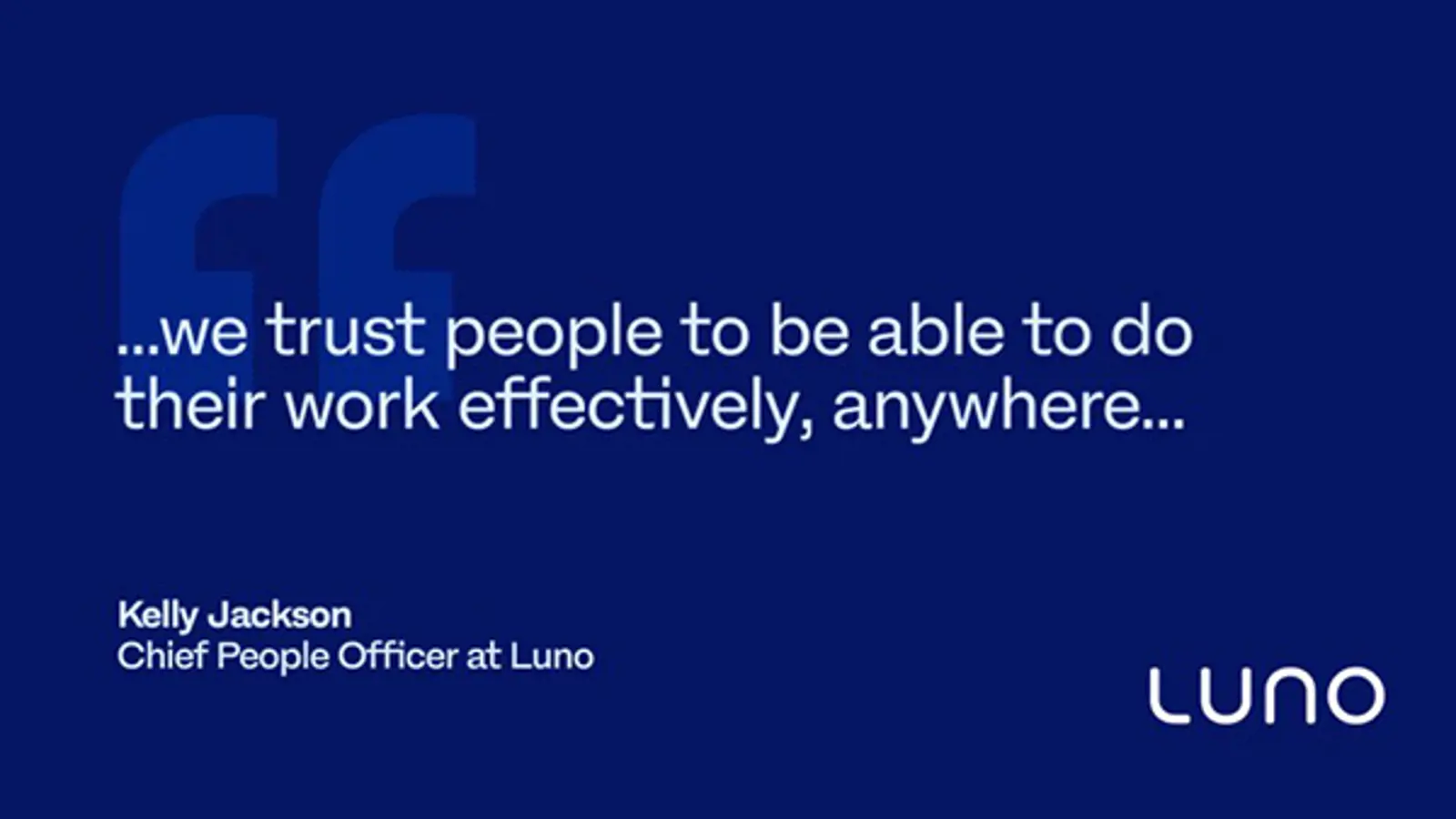
We trust our Lunauts – in essence we trust people to be able to do their work effectively, anywhere and we know there is no one-size-fits-all approach to where we each work best.
We value in-person connection – we believe that Lunauts spending some proportion of their time in-person with each other is incredibly important to both Luno and Lunauts. Not because we believe work is done better in person, but because our business is built on the strength of our relationships with each other.
We value consistency – Remote but Reachable means that working outside of a Luno workplace becomes the default working option for the majority of Lunauts, the majority of the time, rather than something that is agreed by exception or on an occasional basis. We want to ensure that everyone, regardless of their working preferences, has an equal opportunity to develop, grow their career and contribute to the success of Luno.
We keep it simple – By having the same set of principles for all Lunauts, with the same level of flexibility and minimum expectations of in-person connection we are applying simplicity to what is an incredibly complex world.
We will learn and adapt – There is a lot for us to figure out in creating a Remote but Reachable Luno business. We are comfortable admitting what we don’t know. We will act with humility and will continue to listen to our teams and apply our collective intelligence to solving hard problems!
Now that we have had Remote but Reachable for six months, what have we learned?
We really do value in person connection, and are being creative in what this looks like. From renewed emphasis on regional team socials (remote and in person), to walks together, team socials or lunches near to where we live. We realise that being together doesn't always mean being together in the office.
Different teams are finding their own routines. Some teams, or regions, are experimenting with being together in person more frequently, sometimes because there are a lot of Newnauts (new starters) in the team and the team feels onboarding is a better experience when more time is spent together, or simply that is just their working preference, whereas other teams have a less frequent cadence. At the moment, there is no one size fits all. Unsurprising perhaps, but something we are keeping a close eye on.
Great communication is not easy! It's challenging as a globally distributed, fast scaling business at the best of times, so we are prioritising engaging, remote-first communication, and really distilling information into key messages which we repeat, repeat, repeat to reduce the noise across all of our communication channels.
We have to be deliberate about building opportunities for connecting with Lunauts outside of our cross-functional teams. The relationships and networks built pre-Covid over the canteen tables, or coffee machines, and which hold real value, we want to ensure are still built in a Remote but Reachable world. Whether that is donut pairings or groups, virtual Lunch on Luno Fridays, our onboarding buddy system or things we haven't yet thought of, building company wide relationships is still important.
Building a successful company where the default is not the office 9-5 comes with a lot of challenges but also a lot of opportunities to build something even better than what came before. We are committed to building a consistently amazing employee culture irrespective of working preferences, where Lunauts can positively contribute to our ambitions and grow their own career equally. Work can definitely work better!
It’s been a turbulent time in crypto recently, but throughout that time at Luno we’ve been working incredibly hard to raise the bar on what we give our customers, with big product features and enhancements; we’re here to change the world for the better and that takes commitment! The quality of ideas and execution is increasing every day and I’m excited about what we have launching in the next few months let alone the rest of 2023 and beyond.
We’ve had a mantra of “moving fast” throughout, not about people working harder or longer hours, but rather about hacking back unnecessary meetings, ensuring ownership and accountability is clear, making great decisions on the scope of what we build, and more.
Recently we took a day out of the day-to-day for our #MoveFastHack; a hackathon designed to encourage a pause to do exactly that - rethinking slow processes, breaking down barriers or assumptions, accelerating with technology and more. These kinds of initiatives are keeping us sharp and replenishing our energy!
Hacktastic
But this post isn’t about moving fast… it’s about Hackathons. So, what do I mean by Hackathon? It’s when groups of people take time out of their day job to focus on being creative and innovative, and to solve things for themselves or customers that really “move the needle”. Wikipedia has more here.
Our #MoveFastHack is just one of FOUR hacks we’re doing this year. We know that when there is a lot to get done, just getting your head down and burning out the team is the wrong thing to do - instead we must be really conscious of how we’re working, and we must take time to ensure our direction is sound, and experiment with potentially game changing ideas. Teamwork, honest opinions and open debate are foundations of our culture and Hackathons amplify these perfectly.
I am so proud of how the Luno team across the world came together and the incredible quality of the output we saw from just a single day event (and that makes me super excited about a 2+ day event we have planned later in the year!). We had no less than 25 teams and 100 people changing everything from automation for coin launches to better signposting for documentation - I loved it!
Successful Hackathons
We don’t have room for egos here, but I think it’s fair to say that we’ve become pretty good at this hackathon thing through the hard work of the Lunauts that have run the events. I thought it would be helpful to jot down what I think some of those “magic” ingredients are.
Plan and Prepare
First, allow plenty of time to plan. Form a small cross-disciplinary team, give them a small budget for prizes, define the judging criteria, give the hack a name and brand, give them your (senior) support, get buy-in from key people, select the judges, use internal channels to build anticipation, define how people form teams and enter, and more. Don’t underestimate the value of doing the practical basics to make it super-slick.
Give them a focus
One of the most important lessons we’ve learned over time is to give the hackathon a focus. This can be an outcome, an area of interest, or a set of known problems - but ultimately it creates a purpose and a focus for the hackathon.
The quality of output we’ve had using this model is far superior to anything that preceded it, but more importantly the output has also been actionable and useful. It is so easy for a hack to generate loads of great ideas, but none actually get picked up and used because they just don’t fit the needs of the business right now. There’s only one thing more demotivating than not doing any cool hackathons - and that’s doing one but not using anything the teams create when they’ve invested their souls in it!
We’ve got themes ranging from the broad “exploiting the power of crypto for our customers” and #MoveFastHack through to #TechDebtHack coming up next.
Timebox everything
Don’t let the hackathon take over everyone’s day job! In particular, give clear instructions about how long the hackathon lasts. We use two models;
Friday morning through to Monday evening, with the playback session on Tuesday morning. This is our biggest and obviously most expensive hack, allowing for optional weekend hacking (some teams love the weekend hacking, some really don’t want to - we leave it up to them).
Wednesday morning through to Wednesday evening, with the playback session on Thursday morning.
We’re also sensitive to the timezones people are in - which is why we allocate whole days for the hack, meaning our teams in Malaysia or Indonesia can get started when they start their day, not wait for some kind of kick off from those of us in the UK or South Africa.
This constrained time actually helps focus people I believe - it’s a classic entrepreneurship and agile technique, so fits very well.
Have a great play-back session
The excitement during our playback sessions is incredible. Teams are given very specific timing (depending on the number of teams that could be from 3 minutes to 10 minutes), and ideas or templates on how to present back.
For the longer hacks, we LOVE videos and the teams create mind blowing and often hilarious content! For the shorter ones when there is less time to polish, we tend to go with 3-4 slides, a live demo, or just a charismatic presenter (either human, or as we saw this time around, artificially intelligent).
Picking a great host for the event is key too; someone who can keep the mood high, the humour flowing, and the pace fast (and on time!), and even if you work remotely I recommend giving the option for “viewing parties” to form in each office where you can enjoy seeing the entries together.
Follow-through with ideas
Once the hackathon is done, your work is not finished. As I mentioned when discussing having a focus, it’s critical to get value from the hack beyond everyone having fun. This time around we have a page with all the teams on, and have chased up what they’re doing with their idea - that could be creating tickets for prioritisation consideration by Product, adopting a new way of working in their team, or simply storing the output because we learned from it. Making this happen and making it visible to the team are both really important.
Learn and iterate
After we’d run a few hacks, we started collecting all of the information we had about how to run a successful one on a Miro board, which was initially populated by running a retrospective on a previous hackathon. Then, we use those findings to guide running the next hack, and you guessed it - do a retrospective again and add to the board. Over time we’re getting more and more slick!
That’s it!
Well that’s it, short and simple. I love creating space for the teams to innovate, especially if we can use it to have a positive impact on customers, our community, or network; I encourage you to consider it too - the important thing is to get started and start learning… good luck!

What has been your career journey?
After finishing school, I, like many others, was a bit stumped about what career I wanted to pursue. At the time, the best I could do was lean into the subjects I did well in and was most passionate about at the time, namely: Physics, Business Studies and Maths. I believe this is what ultimately convinced me to pursue an undergraduate in Industrial Engineering at Stellenbosch University in 2013, a degree that ultimately taught me to think like an engineer with a business hat on.
Throughout my undergraduate years, I discovered my deepest passions ignited when a module incorporated elements of programming and mathematics. A pivotal point in my career journey occurred right at the end of my undergraduate in 2016 from an unexpected source: YouTube. A recommended Stanford lecture introduced me to the realm of "Machine Learning," a paradigm enabling computers to make intelligent decisions without explicit, programmed instructions. I was hooked! So much so that I decided to pursue a PhD in Data Science and Machine Learning which I successfully defended at the beginning of 2020.
Transitioning from academia, I was eager to discover how my newfound, mostly theoretical Data Science and Machine Learning knowledge could actually solve real-world problems. My first job at a Data Science consulting startup gave me the chance to do just that. I worked on a bunch of different Data Science projects in various industries, which was a great learning experience. I think this experience really prepared me well for the unique problems I would encounter at Luno.
I have been working at Luno for over 3 years now and I’m amazed at the personal and professional growth journey I have been on. During this time, I have transitioned from being more in the fun-loving Customer Service space to grappling with the complex world of anti-money laundering and fraud prevention and, presently, to being deep in Luno’s crypto liquidity space. Each day, I find myself even more amazed at the extraordinary ideas Lunauts bring to the table every day to make Luno the most trusted, safe and welcoming crypto exchange.
What do you enjoy about your role?
The best thing about being a Data Scientist is the variety and depth of the problems that I get to work on every day. Coming from a strong research background, I enjoy the intellectual challenge of trying to crack a really tough problem. Even more than that, the satisfaction I get from seeing that solution driving real value is what gets me out of bed every morning.
What are the top three tasks you would complete day-to-day?
One of the greatest privileges about being a Data Scientist is that your skill set gives you the ability to solve many different types of problems in many interesting ways. In that same breath, no two days ever look the same for me. Some themes of tasks do remain the same though:
Most mornings start off with connecting with my fellow Data Science colleagues in our morning standup. This is usually followed by an informal collaboration session where we can exchange ideas or help each other out if we are struggling with a specific problem. I’ve found having this space to connect is so important especially in this more digital work world we now find ourselves in.
If I’m at the very beginnings of understanding a problem and what possible solutions I am considering, most of my time will be spent engaging in meetings with stakeholders or engineers, reading blog posts on how other people have approached similar problems, searching for data to see if it even exists, or formulating my thoughts on a blank canvas with sticky notes so that I can easily bounce some of my ideas off my other colleagues.
If I’m in the later stages of a project where we’ve already converged on a solution, most of the time I’ll be building out a data pipeline to get the data I need into a usable form, tinkering around with new feature engineering ideas or specific model configurations in a Databricks notebook, thinking about the best way to convey a data insight or preparing for an upcoming presentation to stakeholders.
What are the top skills you need to master to succeed in your role?
This is a tough one. Naturally, as a Data Scientist, one may gravitate towards those hard skills like Python, Statistics or even Deep Learning. Although important, I have found that what really distinguishes someone in this field is their ability to pair their hard skills with some very important soft skills. Here are the top 3 skills I think every Data Scientist should master:
Have a curious mind. The field of Data Science is constantly changing. People around the world are discovering new and interesting ways to solve problems using Data Science techniques. An approach that was state-of-the-art a month ago will soon become obsolete. Although I would definitely not advise going down every new rabbit hole, I believe remaining deeply curious about the Data Science field is incredibly important for fueling new creative ideas to problem solving. Moreover, let this curiosity extend into the way in which you understand and approach people and problems!
Learn how to listen. One of the common pitfalls Data Scientists very often stumble into is rushing into a solution without truly understanding the problem they are trying to solve. It takes a great deal of humility to put all the fancy models and algorithms aside to truly listen and understand the problem a stakeholder is facing. Encourage open dialogue by using prompts such as "Could you share more about your process?" and "Can you walk me through your plan once I provide you a solution?". Listening ultimately nurtures a stronger connection with the problem itself rather than being fixated on a preconceived solution.
Master the art of storytelling. One of the early lessons I learnt in my Data Science journey was that no matter how ingenious your solution is for someone's problem, it won't count for much if you can't explain it in a way that the decision-makers can easily grasp. Slapping a bunch of graphs onto a PowerPoint without considering the journey you're guiding stakeholders through is a recipe for disappointment. Our brains are just not good at retaining raw facts for very long, and they often don’t drive the meaningful actions we're aiming for. Rather, we are wired to understand, retain and deeply connect with people through stories. Take your stakeholders on the journey of how you arrived at your solution. Mastering storytelling, of course, takes practice, and I'm definitely still learning. But one thing you can do is seize every opportunity you get to present, even though it may seem scary at times!
What advice would you give to someone looking to develop into the position you are in?
Leaning very much on the the skills I previously mentioned, there are a few nuggets of advice I would have loved to give myself earlier on my journey as a Data Scientist:
Don’t focus too much on the method. Too often, as a young Data Scientist, we can get caught up in debates like “Should I use Python or R, Plotly or Seaborn, PyTorch or Tensorflow?”. Just pick one! What’s more important is that you are able to extract value from data using one of these tools.
Plan your problem approach. When embarking on tackling a Data Science problem, there is often no shortage of possible solution approaches one could begin to explore. If only one also had copious amounts of time to go down each rabbit hole! Through experience, you’ll get better at predicting which solution avenues are likely to yield the best results and knowing when a path is likely heading towards a dead end. Taking some time ahead to plan out what you are thinking of exploring and validating or even improving on some of these ideas by getting feedback from other colleagues and/or stakeholders can be super crucial to your success.
Understand your solution deeply. I know it may sound obvious, but once you have proposed a solution to a problem, make sure you understand your solution deeply. If, for example, you have proposed a new model that is going to predict fraud, make sure it’s trustworthy by knowing how that model is coming to its conclusions. Don’t only look at metrics like AUC or R2 but rather interrogate your model by looking at how it misclassified specific examples and understanding its shortfalls. In this process, it’s also important to document how you arrived at your solution and all the assumptions you may have had to make along the way. Ultimately, this will build trust in your solution among your stakeholders which will hopefully lead to the desired impact you are wanting to achieve.
What’s been your highlight at Luno?
The crypto landscape is constantly changing and filled with new challenges. Being in a company with the enthusiasm and willingness for innovation makes it so easy to get excited for work every morning. It may sound cliche, but this is why the people at Luno are an everyday highlight! I am truly grateful that I have the opportunity to learn from such incredibly talented colleagues that push me to become the best version of myself. Moreover, I’ve been fortunate enough to have exceptional managers who not only fosters an environment where I can develop the skills I want to grow in but also trusts my opinions and views me as a partner in Data Science discovery.
Mission & Impact: What aspects of Luno’s mission resonate most with you, and how do you feel your role contributes to that mission?
One of Luno's core design pillars is simplicity. If you look at the Luno app, you'll see that we strive for ease of use and user-friendliness. Since one of the company's primary goals is to put the power of crypto in everyone's hands, this philosophy plays a crucial role by lowering the barrier to entry for what is already a highly complex ecosystem. As someone passionate about blockchain, improving the accessibility of crypto—one of its largest use cases—resonates deeply with me.
As a backend engineer at Luno, I have the unique opportunity to influence the user experience more than in a traditional backend role, thanks to our increasing use of server-driven UI. In a nutshell, some of the screens you see in the app are dictated by the backend—from the text displayed to the buttons you interact with, the backend directs the frontend on exactly what to render. Implementing these server-driven screens is when I feel I contribute the most to the intuitive and user-friendly experience that Luno is known for.
Challenging Projects: Can you describe a time you faced a significant technical challenge at Luno and what you learned from the experience?
My team owns an internal cron job that ingests data from a third-party vendor and performs business logic on it. Sometime last year, we experienced a massive spike in data volume—from a daily average of around 700 data points to well over 600,000. This was several orders of magnitude beyond what the job was capable of handling within a reasonable timeframe. As a result, we were at risk of breaching regulatory service level agreements (SLAs) if the data wasn’t ingested on time.
Without getting too technical, I spent the next few days completely refactoring the cron job, parallelizing some of the work, and implementing a different retry strategy. Interestingly, the most valuable lesson I learned didn’t come from the coding exercise itself but from my interactions with the vendor’s engineering support team. I realized that when dealing with an external API, understanding and confirming its behavior under abnormal conditions is crucial for optimizing your solution.
Career Growth: What kind of professional development opportunities or resources has Luno provided that have been valuable to you?
There are two main areas that come to mind when it comes to development opportunities at Luno. The more obvious one is the annual £400 Learnably budget, which has allowed me to attend online courses and read technical books that I otherwise might not have purchased on my own. However, what I’m most grateful for at Luno are the unspoken opportunities.
While Luno has been around for over 10 years and has well-defined processes in place, it still maintains a startup/scale-up vibe, meaning you can make a much larger impact beyond the immediate scope of your role. For example, even though I’m a backend engineer, I collaborate closely with non-backend teams such as product, UI/UX, and others in my day-to-day work. During my time at Luno, I’ve significantly improved my soft skills and deepened my understanding of thought leadership from both technical and non-technical perspectives. If you're paying attention and willing to step outside your comfort zone, Luno offers countless opportunities for growth.
Culture & Innovation: How would you describe the culture at Luno in terms of supporting new ideas and approaches?
One of my favorite things about working at Luno is the openness to trying new things. Case in point: I noticed a bottleneck in how we ship server-driven UI for new user journeys—going from a design file in Figma to code in the editor was taking far too long. Neil, our principal backend engineer, sparked the idea of generating boilerplate code based on manually derived state transitions from the user journey. I took it a step further and asked, "What if we generated the code straight from the Figma file?"
This led me to develop an internal Figma plugin that converts flow prototypes directly into Go code. In typical use, the plugin generates over 500 lines of code with just 30 minutes of effort—a huge time saver compared to manually translating the design file into code, which could take several hours. The plugin has since been used to bootstrap multiple server-driven flows in production, all thanks to Luno’s culture of innovation. My manager, Tim, even allocated dedicated time during a sprint for me to work on it, which speaks volumes about how new ideas are supported here.
Customer Focus: How does your team keep the customer’s needs and experience in mind when developing technical solutions?
One of the best ways to stay in touch with what users want is to be a user yourself! Almost everyone on my team uses the Luno app in their personal lives. By dogfooding (yes, that’s a real term!), we naturally keep customer needs and experiences top of mind since we interact with the app just like our users do.
For example, when our UI/UX designers create the designs for a new feature, the entire team collaborates and reviews them together—not just from a technical perspective, but also as end-users. This hands-on approach helps us build solutions that feel intuitive and user-friendly.
Crypto Ecosystem: In your opinion, what’s the most exciting trend or development happening in the broader crypto space right now?
The crypto space is experiencing unprecedented regulatory action across many jurisdictions, most notably in the US. While regulation was—and often still is—seen as a threat to cryptocurrency’s original philosophy of decentralization and self-governance, it is ultimately inevitable in today’s economic landscape.
What excites me most about this regulatory shift is that it signals the gradual adoption and acceptance of cryptocurrencies and their underlying technologies. I believe that once the legal framework around cryptocurrency usage and ownership becomes clearer, we’ll see real adoption at scale.
Advice for Tech Candidates: What are a few key qualities or skills that you think are important for someone looking to join the tech team at Luno?
There’s a saying my fellow Lunauts like to use: Change is the only constant here. Given the volatile and fast-paced nature of the crypto industry, this couldn’t be more true. Anyone looking to join the tech team at Luno should be prepared to embrace change and adapt quickly.
But with change comes continuous learning. To thrive here, you need a curious mindset and a willingness to make yourself vulnerable in the pursuit of growth—whether that means improving your skills, filling in knowledge gaps, or tackling challenges outside your comfort zone.
Team Collaboration: How would you describe the collaboration within your team or between different teams at Luno?
Collaboration is at the core of how we work at Luno. As I mentioned earlier, I work closely with the product team, UI/UX designers, frontend engineers, and more. This level of cross-functional collaboration is standard practice here, especially when tackling complex projects that involve multiple teams.
For example, on a recent project where we introduced Luno’s first multi-network feature—allowing Nigerian users to send and receive USDT on both Ethereum and TRON—our team had weekly meetings and check-ins with other teams. These sessions helped us communicate progress, address blockers, and ensure that we stayed on track or adjusted expectations as needed.
Team Collaboration: How would you describe the collaboration within your team or between different teams at Luno?
Collaboration is at the core of how we work at Luno. As I mentioned earlier, I work closely with the product team, UI/UX designers, frontend engineers, and more. This level of cross-functional collaboration is standard practice here, especially when tackling complex projects that involve multiple teams.
For example, on a recent project where we introduced Luno’s first multi-network feature—allowing Nigerian users to send and receive USDT on both Ethereum and TRON—our team had weekly meetings and check-ins with other teams. These sessions helped us communicate progress, address blockers, and ensure that we stayed on track or adjusted expectations as needed.
Luno Values: Can you give an example of how you’ve seen one of Luno’s moontality in action within your team?
The most recent example that comes to mind is how our team embodied "Win Together" during the USDT/TRON project I mentioned earlier. To give some context, this was the first time Luno offered multiple networks for sending and receiving crypto. However, our codebase wasn’t originally designed with the concept of networks in mind—the network was simply implied based on the cryptocurrency.
To make this work, multiple teams had to refactor large portions of the codebase. Through constant communication, leveraging each team’s strengths, and actively unblocking one another, we successfully brought the project over the finish line. It was a true demonstration of collaboration and shared success.

What’s the first thing new starters experience when they join us?
Like most companies, Luno evolved significantly through Covid, rethinking how we work, collaborate, and connect across the globe. But one thing we’ve never compromised on is the power of in-person connection.
To help new joiners experience that connection from day one, we created Culture Day, a full-day, in-person experience designed to bring our story, purpose, and culture to life.
Culture Day goes beyond the standard onboarding session. It’s a deep dive into who we are, what we stand for, and where we’re headed — helping new Lunauts see the bigger picture and feel inspired about the incredible journey they’re about to join.
What exactly is Moontality?
It’s our set of values that guides everything we do at Luno. But they’re not just words on a wall or catchy phrases on our website. Moontality is lived and felt every day, in how we show up to meetings, how we collaborate, and how we create a culture where people feel heard, supported, and inspired to do their best work.
It’s what makes Luno, Luno and what truly sets us apart.
What happens on Culture Day?
Culture Day is your first impression of life at Luno — and we know that first impressions matter. It sets the tone for your journey with us, it can’t be redone or replaced, so it has to deliver. Our goal is to make sure every new Lunaut leaves feeling inspired, informed, and set up for success.
The day focuses on three key areas: our culture, our industry, and the Luno story. These themes come to life through a series of engaging, storytelling-style sessions led by some of our OG Lunauts, the ones who’ve helped shape Luno into what it is today. It’s not just about learning, it’s about connecting, expanding your network, and hearing firsthand from those who’ve walked this journey before you.
Why does Culture Day matter?
Culture Day matters because joining a new company can be overwhelming. There’s so much information to take in, like new systems, new faces, new ways of working that it’s easy to get swept up in the day-to-day before truly understanding what makes Luno special.
We don’t just hire people for their skills, we hire for fit, mindset, and heart. Because at Luno, success isn’t only about what you can do - it’s about how you show up, how you collaborate, and how you help others succeed alongside you.
Culture Day gives our Newnauts the space to pause, to connect, and to really understand what it means to be part of this journey. When we get that buy-in from day one, when people feel that shared sense of purpose and belonging, that’s when the magic happens.
Why is it important to communicate this externally?
My hope is that for anyone considering a career at Luno, Culture Day sends a clear message: from day one, we prioritise your experience. Our People Experience team is intentional about creating moments like this, moments that help you feel connected, understand what truly matters at Luno, and set you up to succeed.
Onboarding isn’t just about learning processes or systems, it’s about immersing yourself in our culture, enjoying the journey, and feeling part of something bigger. If you’re thinking about applying to Luno, we hope this shows that we don’t just hire people who can do the job, we hire great people we want to work with. People who can grow, collaborate, and thrive alongside the best, in a space built for success and connection.
Check out our careers page and see where your journey at Luno could begin.